Garrison
Installation and persistent base operations on commercial 5G, including upgraded existing towers.
Secure 5G
Cipherlynx turns commercial 5G—including upgraded existing 3G and 4G towers—into a secure network that lets warfighters reach unclassified, Secret, and Top Secret systems (NIPR, SIPR, and JWICS) from one standard Android device, from garrison to the tactical edge.
Built to see clearly when the environment does not.
Mission
Give warfighters a secure path across every classification from a single standard device, on commercial 5G, wherever the mission is.
The requirement
Military communications still ask too much of the operator. Separate devices for separate classification levels. Legacy towers that are costly to replace. Positioning and timing that fail when GPS is denied. Networks that go dark when the link back is cut.
Cipherlynx applies one secure architecture to commercial 5G, including the 3G and 4G towers already in place. Traffic is isolated by classification, protected with trust management and post-quantum cryptography, and carried on a local 5G core that continues to operate when disconnected. SATCOM in LEO, MEO, and GEO extends the same architecture when terrestrial links are not available.
Platform
The same design serves the garrison, the forward operating base, the safe house, and the warfighter on the move—backed by SATCOM, and able to stand alone.
Installation and persistent base operations on commercial 5G, including upgraded existing towers.
The same architecture, deployed expeditionary, with a local 5G core at the point of need.
A fixed, discreet configuration for small teams that still need full classification reach.
On-the-move communications for troops at the tactical edge, on the same network design.
Interoperability. Designed to interoperate with fielded tactical systems, including PRC-117G and PRC-152, HF, ANW2, Link 16, TTNT, CDL, and Trellisware.
Capabilities
Built on open standards and designed for contested environments—from the tower to the device.
Reach NIPR, SIPR, and JWICS from a single standard Android device. Each classification runs in a separate trusted container, isolated on the device and in the network.
Built on commercial 5G. Existing 3G and 4G towers can be upgraded into the secure network, without a rip-and-replace of the installed base.
Open RAN hardware and network slicing keep users and classified traffic on separate paths through a shared 5G system.
Resilient PNT maintains positioning and timing when GPS is denied, so the network stays oriented and synchronized in contested environments.
Trust management, quantum and post-quantum cryptography, and implicit certificates protect the network against current and emerging cryptographic threats.
LEO, MEO, and GEO SATCOM extend reach. A local 5G core continues to operate when disconnected, from the forward base to the 5G backpack.
Multi-level security
Classification is enforced in layers—on the device, in the authorization path, and in the 5G core—so traffic for each level stays on its own plane.
Each classification level runs in a separate trusted container on the device, using SELinux and a TPM root of trust.
Access is granted through two-tunnel authorization, so each path is independently authenticated and encrypted.
A distinct 5G core path is maintained for each classification level, so traffic does not share a classified plane.
In the field
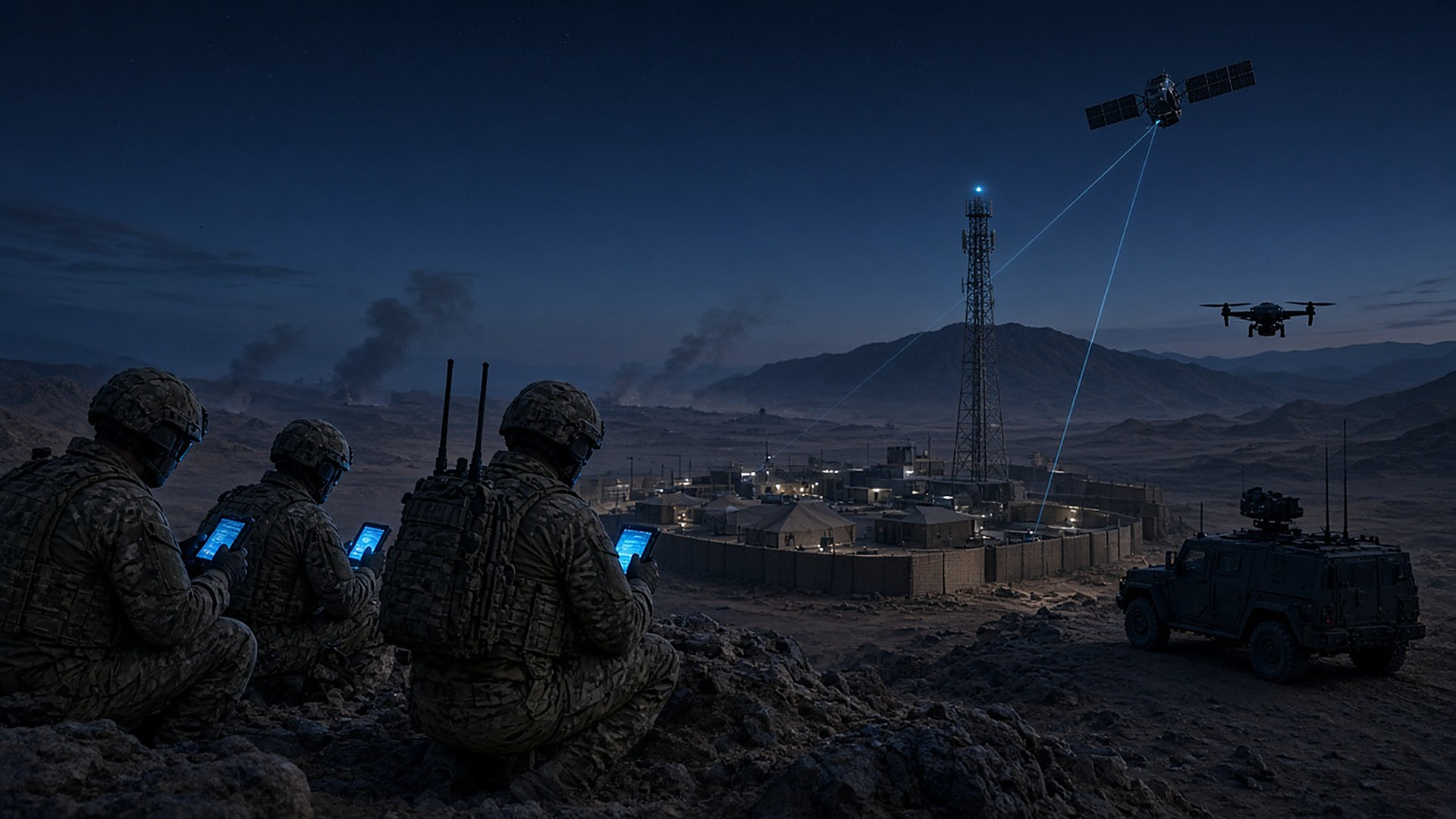
The same architecture, from a standard handset to the satellite, illustrated in a forward environment.
Each network lives in its own sealed container on a standard Android phone, anchored to a TPM hardware chip.
Key 1 opens the local 5G core. Key 2 opens the classified network. Both checks must pass.
NIPR, SIPR and JWICS each run in their own lane, kept apart by network slicing.
A complete local 5G network carried on the move by a single operator.
LEO, MEO and GEO SATCOM (and airborne nodes) link the site back to DISN services.
Local 5G core keeps services running if cut off. Tower upgrade: in development.
Resilient positioning, navigation and timing built into the 5G system.
Illustrative concept image. Not an actual deployment.Designed to align with NSA requirements; accreditation pending.
Use cases
The same platform supports base modernization, expeditionary operations, and partners who need a secure, standards-based 5G path.
Upgrade existing 3G and 4G infrastructure on installations to secure 5G, and give the garrison a path to NIPR, SIPR, and JWICS from a standard device.
Deploy the architecture at a forward operating base, with a local 5G core that continues to operate when disconnected, and SATCOM when a terrestrial link is not available.
A 5G backpack and safe-house configuration extend the network to small teams at the tactical edge—on the move or in place—with the same classification reach.
A standards-based, O-RAN architecture is designed for environments where partners must interconnect without abandoning their own equipment.
The same secure-communications approach can support civilian and interagency networks that require strong separation, resilient timing, and continuity when links fail.
Status and path
Cipherlynx is a secure-communications company for defense, delivered on commercial 5G. The architecture is designed to align with NSA requirements; accreditation pending. Briefings are available to government and qualified industry partners.
Field demonstrations of the architecture across garrison and expeditionary configurations, including operation on upgraded existing towers.
Continue the accreditation process for use on classified networks. Designed to align with NSA requirements; accreditation pending.
Make the platform available for programs that need secure 5G, from base modernization to the tactical edge, and to allied and interagency partners.
Contact
If you are evaluating secure 5G for a government program, a prime contractor team, or a qualified industry partnership, we will walk you through the architecture, the configurations, and the accreditation path.